

Wilnona Marie is the co-founder of AITL Media, a boutique literary PR and media strategy firm, and co-author of 17 books with Jade Dee. The collection And I Thought Divorce Was Bad hit bestselling on Amazon’s poetry charts and led to both of them being assigned as US correspondents on the UK’s Sky TV show Chrissy B. She has spoken at PNWA, Penn Writers Conference, Johns Hopkins University, the University of Baltimore and the Maryland Writers Conference.
Orangish hues, pink outlining, and slivers of white cloud on the light-blue sky caressed the ruins of Athens, Greece. We had ten days of tour left in europe and absolutely no cash. The ruins of Greece witnessed another tragedy, but not one as big as the 300 Spartans. The bank had called to tell me I was negative in my bank account, due to yet another bank error on their part. The first time a bank error wiped out our account, I assumed it was a clerical hiccup, but by the tenth time, which is the one I described above, it had become a part of life.By the time it was all said and done there were 13 bank errors. I had started to feel like the bank and I were in a relationship, and not a healthy one.
Stranger than the bank errors was the literary life we were experiencing at that time. Jade Dee and I were visible to the public because we starred in a docuseries distributed on Amazon Prime. The show was about authors’ lives behind writing the books. We toured England, Paris, Greece, and Spain to hype up the show and our latest literary life guide, aka our poetry book. We attended Senate luncheons and turned up in international magazines. Then on the next day we cleaned houses, because the month’s bills still needed to be covered.
Other authors assume the visibility and income arrive simultaneously, like a couple walking into a party perfectly timed to show off each advantage. Our money had indeed arrived but in separate cars driven by multiple guests into our own financial shindig. Then, like a fall on the red carpet, the bank error lost it all over and over again.
Once the good news arrived about our career, there was just the waiting, then quiet panicking, saying positive mantras that this time it would be different when the money arrived. It was like the money didn’t get the invitation to our party. If you have just entered the world of sudden literary fame, this is for you.
Shock Has Terrible Priorities
The shock of losing our monetary foundation does something odd to one’s attention. The floor drops; your brain fixates on what can be done to reestablish normalcy, be it the pretense or the actuality. We learned new priorities to deal with this.
Looking established in the public is not always the same view from being the person inside the fame. While glamour was showing to all who could see us, inside we were rebuilding from zero with excellent lighting. Inside that sparkle and shine twinkled less as we used our elbow grease and sheen of our sweat cleaning to fill in the gaps in income between the valleys of minus dollar amounts in our bank account and the requirements of the public life.
We learned the difference between the mirage of literary fame and the fiduciary responsibilities of life not being met. When faced with the desert of a blank account, we attempted to populate it by learning new skills. These skills and corresponding jobs expanded our writing and the characters in them. The one job we found hilarious to do while walking red carpets was cleaning houses.
In our latest novel, The Famous House Cleaners, we delve into the inequity of perception and realities of wealth and being socially acceptable in a place where you no longer fit. This was a very recognizable scenario in our own life. Almost everyone has been a fish out of water or overwhelmed by life’s sudden challenge.
What We Stopped Paying Someone Else to Do
Over the years, we developed a system to anticipate the highs and lows of creative life, including another bank error. From this, we learned how to build our own monetary foundations in our life, so we could stand on our own while the battery of life’s small bills piled up like a lighthouse beaconing doom to our shores
Learning from my past in the years between publications I tried to piece together solutions. One of those experiences happened when I was twelve. I invented a mystery series and mailed it, one book at a time, to readers from Massachusetts to Florida. Fifty-six books. No agent, no publicist, no budget beyond stamps.
I forgot that lesson somewhere along the way, and the lean years reminded me that I had the sprouts of the information to help us. Publicity had become something we bought. We would find the person with the contacts, pay the retainer, wait for the phone to ring, and proceed on with life, not thinking about the cost. When the money vanished, so did the retainer, and we had to relearn how to work ourselves.
It was a steep learning curve because I wasn’t an adorable twelve-year-old with a dream. Jade and I learned how to pitch the media and get replies without getting silence. Our gift for gab translated into relationships with editors, producers, and executives before we needed anything from them. We learned that persistence with good manners is one of the best, least-traveled roads to getting the yes we desperately needed. That education became AITL Media, our boutique literary PR firm, an author-central publicist firm. Eventually, we learned how to attain a phone number and find the nerve to dial it. This skill allowed us to create our own paths. It also became a knowledge set nobody could charge us for again, unless by choice. Finding that what we knew was about 15% of the knowledge base, we dedicated ourselves to learning the rest.
The Ladder That Freed Us
Thirteen money rebuilds from zero teach a curriculum no formal MBA offers. The diploma of hard knocks is successfully balancing life as a creative. Life experience will give you a class in glamour and scrub brushes, as we learned on the day we changed our clothes in the car to attend the Emmys after cleaning four houses. So that’s not you, here’s what we learned.
- Layer your income so no single late check can ruin your month. This is about finding more revenue streams. A book, in our experience, can have multiple ways to bring in revenue. Look at yourself as an author. Is there knowledge you have that is worth teaching, speaking about, or even discussing with others?
- Run on the cash you actually have, so a bad month doesn’t compound into a bad year. We tend to cut all purchases beyond what our savings or investments can pay for; then we use only the cash we have on hand for these financial catastrophes.
- Break the big, scary number of household bills into a daily target, because you can’t act on a year, but you can act on today. An unexpected $3,000 bill becomes a hundred dollars a day. That’s doable. We make a plan to get the hundred. Some days we meet the goal; other days we don’t, but either way you know you’re making headway.
Jade turned her version into the $12 Snowball System into a few steps, to create a factory for money in our life. When we had an extra $12, Jade focused her thoughts on margins, dividends, and stocks. She invests $12 and moves it between our multiple investments to create a constant income.
This wasn’t a huge adjustment for Jade. At six, she was collecting cans for extra money to supplement her allowance. Within six months, she was paying her employee and had an established route that paid well. I was 100% behind her. I jumped in to try to help with what I had learned. At nine, I took stock trading classes from a man who later became a billionaire. Later, I negotiated my first land deal at nineteen. That sounds impressive until you remember a bank still took everything thirteen times. Neither preparation for life nor notoriety makes a person immune to hiccups of everyday stress. It will make you fast and adaptable to the situations as they come.
The real prize of several income streams is not money but the ability to stay in the life you choose. When the book is the only paycheck, anything looks like a lifeboat when financial trouble is flooding the base of your life. You take the bad contract and the unpaid appearance that eats a week, and you discount yourself before anyone asks. Desperation is a terrible negotiator and always shows up at the worst moment. With books, speaking, publicity, and our own platforms each carrying a little weight, we could turn down what didn’t fit us and say yes to what did. Even with these systems in place, the fear of being negative in the bank and still owing money is formidable.
The Day Job Becomes the Plot
Cleaning, for me, was an embarrassing footnote. The people in the same rooms with me weren’t thinking about mops and running ROIs on disinfectants. The section of my life outside a gown was the premise worth writing about for my creative life.
The books could mirror the absurdity of my life. That’s why, in the book, Violet and Pete Peterson are adopted sisters and tech entrepreneurs who lose everything to a bank error and take cleaning jobs inside their own gated community. They are famous and in the public eye in a way we never were, but extending our world to what could have been makes us process the strong emotions attached to the trauma of instability.
The comedy came straight from the work. One client had a vacuum like Big Bertha. It moved like it had its own intent, ate shoelaces, then dragged us around the rooms we cleaned. On the page, it drags Pete across the carpet while Violet holds on for dear life. Anyone who has owned a bad vacuum has met Bertha. In another book, Pete walks into a cloud of curtain dust and emerges looking like a damp poodle dipped in drywall. We explore and exaggerate how a body under stress reacts in the oddest ways. Violet tries to flee a bakery and finds herself doing the Hokey Pokey with her own feet. A body under stress does exactly that.
To me, the scenes work because the stakes under them are real. We are those women cleaning houses to pay their bills, trying to meet the mortgage, and hiding amongst those who see cleaners and their livelihood as a disposable service. Even while we were going through these months, it didn’t interrupt our writing. We wrote seventeen books and never missed an appearance.
What I’d Tell You Over Coffee
There is no such thing as a fraud as long as you are doing the work. You are in the gap, and there are many artists there. It’s a very crowded space and a longer journey across the gap than anyone expects.
Tell one trusted person the truth, because it’s hard to carry the burden alone. Find a plan that works for you. Look at what you have and find those streams of income to shore up your finances before you need them. Lastly, choose the friends who will be by your side. Treat any second, third, or even fourth job as research. Remember, we find inspiration everywhere, be it in Athens while on the phone with the bank or behind a scrub brush on your knees scouring a kitchen floor. Life is rich with stories.
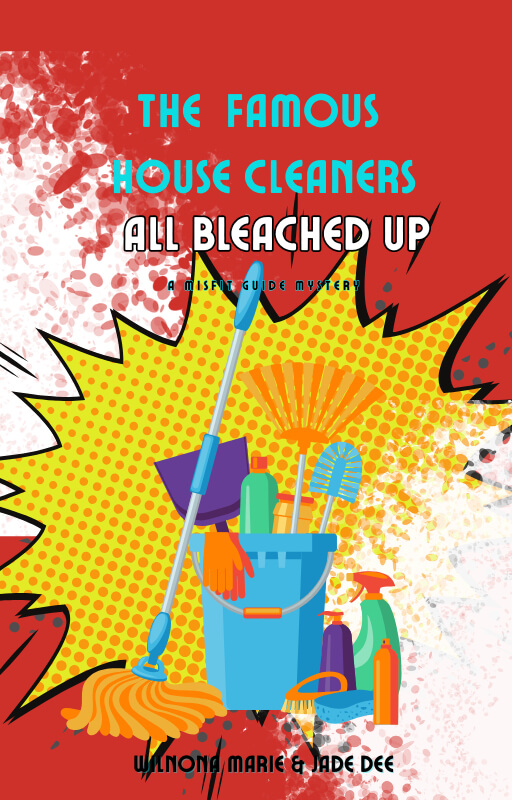
The Famous House Cleaners All Bleached Up by Wilnona Marie
After sisters Violet and Pete Peterson lose $7.2 million overnight, the Tech Darlings take on a charity cleaning job to earn quick cash. Instead, they stumble upon a hand-drawn murder plot—but the woman responsible dies before she can explain it. With a mysterious black book suggesting a much larger conspiracy, the sisters must uncover the truth before the town’s darkest secrets bury them for good.
Buy the book now: Bookshop.org | Amazon










Leave A Comment