

I never had the childhood dream of becoming a writer. I was a book lover, yes. A reader. But writing one myself? No.
At twelve, I wanted to become an actor. My parents were not exactly huge fans of that idea. Let’s say they saw very little career potential in it.
Writing books came much later. More than forty years later, to be exact. The first grey hairs got there before the first manuscript did.
There was no manuscript hidden in a drawer, no five-year publishing plan and certainly no idea that one day I would be thinking about translations, international editions or a third book.
There was simply a story I could not leave alone.
At first, I thought I was writing about a scam. That turned out to be only the beginning.
The obvious story was what had happened. Someone enters your life. Trust is built. Money disappears. Afterwards, everybody can point to the moment where apparently you should have known better.
Only life does not happen afterwards.
When you are living it, things can look completely normal while they are slowly becoming anything but normal. That was the part that interested me. Not only the fraud itself, but the way trust is built, the way doubt arrives, and the way control can shift without a dramatic moment announcing that it is happening.
That became the first part of the SCAMMED series, SCAMMED: The Inside Story of a Perfect Trap.
I chose psychological suspense, and I wrote it in third person. I needed some distance from the facts and from my own emotions. I did not want to write a police report with chapter numbers. The characters are partly fictionalised, but the spine of the story is very real.
I wanted the reader inside it. I wanted that uncomfortable thought to appear: this sounds real. Because from the outside everything is easy to judge. From the inside, not so much.
And then came the part that was not fiction at all.
The questions. The bureaucracy. The financial system, which I suddenly had to learn my way around. Lawyers. Regulators. Different countries. Different procedures. Too many procedures, if you ask me.
One person referred me to another. One department pointed to the next. Everybody seemed to have one small piece of the answer, but nobody seemed to have the whole picture.
At some point I joked that the story should become a movie, because every time I thought the end was finally in sight, another scene appeared.
It fascinated me. It also made me sad. And, quite often, mad.
Probably more than the scam itself.
Because once you start pulling at one thread, you quickly discover there are ten more attached to it.
I also must admit that I could not solve every part of that puzzle completely on my own. Some people helped me navigate certain parts of it and understand who may have been behind the scam. Almost four years later, I have names. I have pieces. A lot more of the puzzle is filled in than it was at the beginning.
But everything I do with that information, every step I take, I do within my own capabilities.
Long before I became a writer, I had already become my own advocate.
That happened because the story in real life became a (US) court case. No lawyer standing next to me. Just one person, a lot of reading, a lot of documents, and the growing realisation that if I wanted certain questions asked, I was going to have to ask them myself.
So that person became pro se.
Also not exactly part of the plan.
I have no interest in being the victim in this story, and I am not interested in playing that role either. I wanted to understand what happened, look forward and keep moving.
But there comes a point where you simply get tired.
Tired of the bureaucracy. Tired of asking the same question in a different way. Tired of being sent from one person to another. Tired of having to understand systems you never asked to understand in the first place.
And sometimes, despite all the people involved, it feels very lonely.
Maybe that is also why I started writing it down. Not as a diary. That has never interested me. I wanted to turn a real event into a story people would actually want to read.
And yes, I added humour. Quite a lot of it in places. Because if you lose that part of yourself somewhere between the letters, the files, the procedures and the next unanswered question, the whole thing starts to eat you alive.
Writing did not solve the bureaucracy. It did not produce all the answers either.
But it did make one thing clear: the story had become much bigger than the original scam.
Book Two grew out of that.
That became SCAMMED: The Price of a Broken System, One Letter at a Time.
The title is quite literal. Sometimes a system does not reveal itself in one spectacular collapse. Sometimes it does it in a letter. Then another one. Then an answer that raises two new questions. Then silence.
And now there will be a Book Three.
That is the slightly ridiculous part. The framework already exists. I know what the book is about. I know where the story stands.
What I still do not know is how it ends.
Reality has not decided that part yet.
There are still answers I am waiting for, and depending on those answers, the book can go in one direction or another.
Meanwhile, something else happened.
SCAMMED stopped being only a writing project. It became a publishing project. Then an international publishing project.
That part was planned. Once I had decided to publish, the goal was simple enough: I wanted the story to be readable beyond one country and one language.
The books moved into English, French, German, Spanish and Italian, with more to follow as the series grows.
That created another education I had never asked for: distribution, Amazon marketplaces, metadata, reviews, discoverability, translations, covers, descriptions, and the mildly absurd number of small decisions hiding behind the sentence, ‘I published a book.’
You discover very quickly that publishing a book and getting a book noticed are two completely different jobs.
A book can be available almost everywhere and still be almost invisible.
Then one person finds it. Reads it. Sends a message. Recommends it to somebody else. And suddenly all those small, irritating publishing decisions feel slightly less pointless.
That part still surprises me.
I still do not think of this journey as something that started with ambition. It started with irritation, disbelief and too many unanswered questions.
Book One is out. Book Two followed. The series moved into more languages. And Book Three is already in the making, even if reality is still refusing to hand me the ending.
And somewhere in the middle of all that is a woman who does not take ‘no’ as a final answer simply because somebody has closed a door.
Closed doors can open.
Sometimes you knock politely.
Sometimes you keep knocking until somebody finally says, ‘We need to talk.’
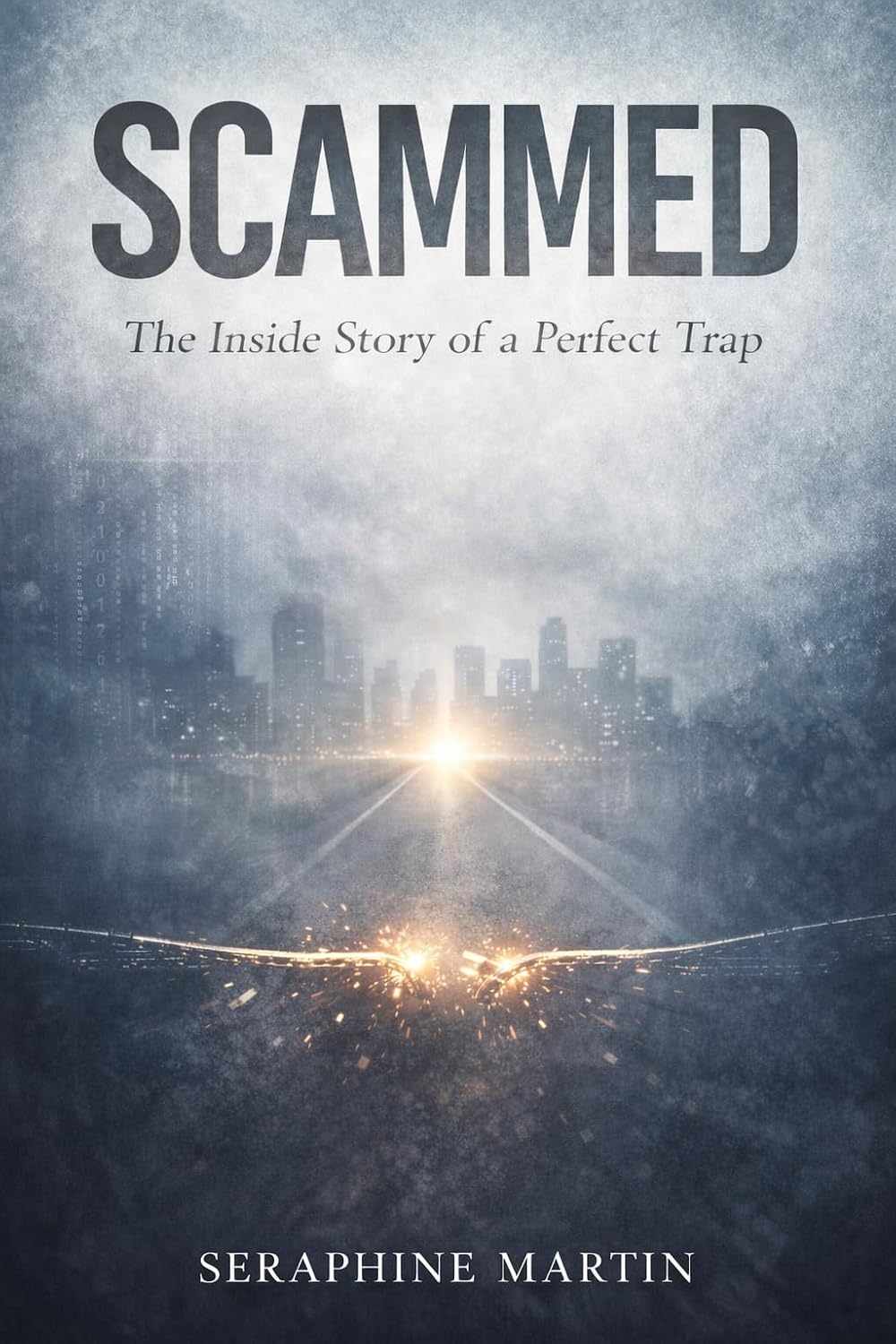
SCAMMED : The Inside Story of a Perfect Trap by Seraphine Martin
An innocent online connection spirals into a dangerous web of manipulation, control, and deception, leaving one woman questioning everything she thought was real. Inspired by true events, this psychological suspense novel explores the devastating consequences of misplaced trust as she fights to uncover the truth and determine whether any of it was ever accidental.
Buy the book now: Amazon










Leave A Comment