

Emily Wibberley and Austin Siegemund-Broka met and fell in love in high school. Austin went on to graduate from Harvard, while Emily graduated from Princeton. Together, they are the authors of several novels about romance for teens and adults. Now married, they live in Los Angeles, where they continue to take daily inspiration from their own love story.
Co-writing with your spouse means getting to watch the person you love excel in their work, using skills that weren’t the reason you fell in love with them, yet are no less marvelous to witness. It’s the unique joy of experiencing your partner the professional. The feeling of going to office parties with their coworkers and hearing praise for their work—except you’re the coworkers, and the party is every day.
It means sharing one of your own dearest interests with someone no less passionate, with perspectives sometimes just like yours and sometimes fascinatingly distinct. It’s like long dinnertime discussions of what you’re reading, what you find engaging, deficient, interesting or incomplete—except you’re the writers under discussion, and you can change the ending.
We’ve been married for seven years of our seventeen-year relationship. Like in real marriage, the heart of our “creative marriage” has been the fundamentals that never change.
Over our decade-long career, though, we’ve been lucky to learn something from marriage that’s permitted our co-writing relationship not only to continue, but to expand and flourish. Marriage is the perfect practice in resiliency, in recognizing how new circumstances don’t mean you need to hit “Pause” or revaluate. Instead, you can—and must—adapt, not just as one person, but as a team.
The non-writing equivalent is easily imagined—when finances, kids, jobs, geographies, extended family, health, pets, hobbies, or whatever else changes, so does the structure of every day. Maybe lazy morning coffees change into hectic schedules of getting everyone out the door. Maybe new neighborhood hotspots replace old rituals. Maybe nights when little ones have gone to sleep become invaluable pockets of quiet to catch up with each other.
We started dating when we were seventeen years old. We started writing together when we were right out of college. We sold our first book when we were twenty-four. In the ten years since, we’ve gotten engaged, then married, sold twenty more books, moved three times, finished professional schools, switched careers, adopted dogs, and most importantly become parents together. Everything in our life would be unrecognizable to our seventeen-year-old selves except for one constant: each other.
The same could be said of our creative marriage. When we were twenty-two, we were still writing out of our parents’ homes. We developed a method that worked immediately for us—we outlined a book together and then we wrote it together. One computer, the two of us in the same room, ideas and words traded back and forth until we were both satisfied enough to type it into our document. It was fun, funny, slow, exhausting. We were inspired by each other, and sometimes incredibly irritated by each other. Honestly, it only worked because we had a lot of free time and we wanted to spend that free time together. We faced everything together—every rejection (of which there were many) was made easier by having a partner who understood completely. We believed in each other more than anything, and that helped us believe in ourselves and keep going.
But our lives changed. As we built new routines as a married couple—with new jobs and responsibilities—and sold books in new genres and had new deadlines, the amount of time we had not just for each other but for writing also dramatically changed. Every time we reinvented our personal routines similarly required us to reinvent our writing process. Ultimately, it’s led us to the same realization—like those logistical upheavals can remind you that the core of your compatibility remains unwavering no matter the practical details, so do new constraints and demands on the form of the co-writing process only reveal how the fundamental virtues you value in your cowriter never change.
Our original co-writing method, while helpful for maintaining consistent narrative voices and reducing editorial exchanging of pages, was slow and invited petty fighting over word choice. With diminishing spare time, we were forced to switch up our process. We moved to swapping chapters and incremental editing back and forth. We couldn’t have begun our career this way—it requires a level of trust in your co-writer and a level of confidence in your own abilities that we didn’t possesses at twenty-two. Similarly, at seventeen, there is no way we could have jumped right into the marriage we have today.
But we took our time. We grew and changed together. We built a sturdy foundation over years and years that today allows us to do pretty much anything.
Like having a baby. The biggest change to both our marriage and our co-writing was the birth of our daughter last year. Time to do anything together, let alone write together, dropped to pretty much zero. Everything in our writing process became iterative—one of us fine-tuning the logline, the other expanding the premise; one of us constructing the outline, the other crafting the prose; one of us offering editorial direction, the other playing and polishing with on-the-page details. Just like we trusted each other to wake up in the middle of the night and tend to our daughter while the other caught one more hour of sleep, we trusted each other to take a whole chapter without previously discussing what might happen in it.
What remained ever-present was the eagerness to work together. The joy of discussing new ideas in front of one computer changed into the joy of discovering new ideas laid for us like diamond crumbs whenever we took over with the computer for the night or the morning. Whether in one conversation or days of scraps of exchanged outlining, the remarkable relief of watching the person whose skill you so revere doing their thing never felt less remarkable. In fact, the changes only underscored the constancies.
The experience of holding onto what’s important in marriage despite ever-evolving circumstances—the emotional connection, the mutual respect, the shared joy of each other’s company—was ultimately the perfect example for the way the co-writing process can, and sometimes must, change to fit new circumstances of cowriters’ lives. Instead of putting co-writing on hold until conditions felt perfect, we feel fortunate that we knew we could lean into the changes instead.
In both life and writing, the shape of our connection has evolved, but never the substance.
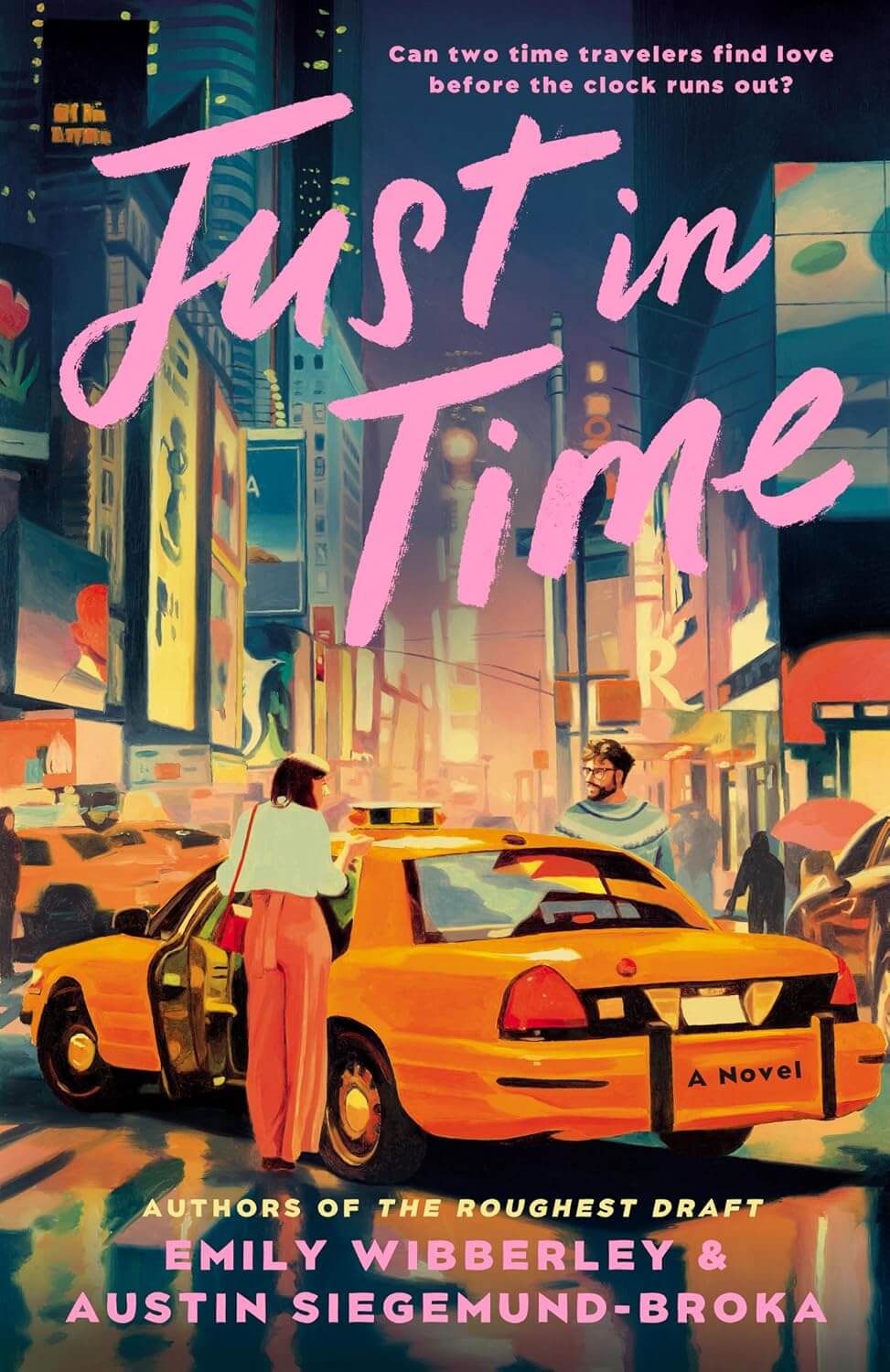 Just In Time by Emily Wibberley and Austin Siegemund-Broka
For Gwen Bailey, taking a cab in New York is life changing. All she has to do is call a taxi, mutter a time in her past, and she is transported to that time. It’s the perfect way to erase mistakes. All Gwen has to do is hop in a cab and redo whatever error she made. She doesn’t know another soul with this magical talent until she meets Ian. Ian uses his time travel to help other people, especially his family. He can look out for his brother and even reverse tragedy, but he finds himself losing touch with the present. That is until he meets Gwen. As they run across New York together, a friendship and an attraction form, but the complications that come with time travel arise. As they fall for each other, Gwen and Ian have to decide between an flawed future or a pain-free past.
Buy the book now: Bookshop.org | Amazon













Leave A Comment