

Jennifer Keishin Armstrong’s writing takes readers behind the scenes of major moments in pop culture history and examines the lasting impact that our favorite TV shows, music, and movies have on our society and psyches. She investigates why pop culture matters deeply, from The Mary Tyler Moore Show and Seinfeld, to Sex and the City and Mean Girls, to Beyoncé, Taylor, Chappell, and Sabrina. She has written eight books, including the New York Times bestseller Seinfeldia, When Women Invented Television, Sex and the City and Us, and the forthcoming Parks and Rec. She also co-founded the Ministry of Pop Culture newsletter.
In the 2000s, I was lucky enough to land a job as an assistant at Entertainment Weekly magazine in New York City. The gravity of this was not lost on me, even in the moment. I’d spent the first five years of my post-journalism-school career at local newspaper jobs, reporting on small-town city councils and earning less per year than I’d paid for Northwestern University. I’d spent a weird year editing a group of home décor trade magazines, including Accessory Merchandising and Residential Lighting, just to get out of newspapers. So it was a pretty big jump to land at a national magazine I had named as my dream job in college.
It didn’t disappoint, either. I interviewed celebrities on red carpets at movie premieres and the MTV Video Music Awards, meeting everyone from John Mayer and Cameron Diaz to Paul Newman and Tom Hanks. I roamed after-parties, mingling among famous people in designer gowns while I was dressed mostly by Target and Express. I interviewed Donald Trump in his office when he was hosting The Apprentice, visited the “sets” of reality shows like America’s Next Top Model and The Hills, and eventually the actual sets of big scripted hits such as Grey’s Anatomy and Lost.
On nights when I wasn’t working, I built a vibrant social life via the city’s young literary scene, attending readings in dark bars below 14th Street and drinking Pinot Grigio for dinner.
More recently, I was telling a young friend about this part of my life. She’s 27 and trying to figure out her direction, and I was explaining how hard I had worked at this time, and also how much fun I had, and also how it had determined the direction of the rest of my life.
She looked at me in genuine awe and said, “Your life was like an Anne Hathaway movie!”
There are ways in which this was right, and ways in which it was wrong. But I understood the sentiment. And I understood that my 20s and 30s had become a period piece. The job that transformed my life no longer exists, at least in any meaningful relationship to what I got to experience.
We didn’t know it then, but we were living through a time that was not exactly the peak of magazines—that would have been earlier, probably in the ‘80s or ‘90s—but the last good time. As my friend was alluding to, it seemed as if nearly every heroine of a hit romantic comedy in the 2000s worked in magazines, most notably Hathaway’s character in The Devil Wears Prada, but also Kate Hudson in How to Lose a Guy in 10 Days and Jennifer Garner in 13 Going on 30, among others.
Since then, most major magazines have suffered layoff round after layoff round. Entertainment Weekly’s first major cut happened in 2008 when I was still there, and it felt catastrophic and unthinkable, the way that American politics feels now nearly every day. We cut half our staff then, at the same time demand to fill the internet space increased exponentially. We all had to take “shifts” to put stuff online, whatever was happening, even those of us who had worked up to the title of “senior writer,” a position that once allowed its occupants to sit in their offices, think deep thoughts, and emerge every few months with A Big Idea. Now I was live-blogging the VMAs on a Sunday night, leaving dates early to recap Grey’s Anatomy, and writing news briefs about stuff I knew nothing of, like whatever was going on with Twilight.
This, too, looks like the good old days now that Entertainment Weekly is completely out of print—yet, oddly, still called Entertainment Weekly—and long features and in-depth criticism is mostly a thing of the past. It’s no fault of anyone working there; it’s just the way the media world has trended, and Entertainment Weekly is far from alone.
User-generated content has all but obliterated the job I used to have. Creators on TikTok now take the place I once had, but they don’t necessarily get paid, which is among the many issues this shift raises. Celebrities are increasingly filling this spot, too, doing the paying jobs that once went to journalists—hosting podcasts, writing books, starting newsletters, and interviewing each other. I don’t begrudge them doing what they can to make a living—their livelihoods are under attack, too—but we lose something when we eliminate meaningful cultural criticism and experts who can place our culture in context. Celebrities simply celebrating themselves and each other contributes to the death spiral our culture seems to be in, full of reboots of reboots and little original thought. (There are exceptions, like Amy Poehler, whose Good Hang demonstrates her rare combination of empathy and attention, and the ways that her improv skill translates into true connection.)
AI, on the other hand, can perform some of the same functions I once performed as an assistant, like aggregating news, which is a shame because those entry-level jobs are particularly valuable to people like me. I got the job with no fancy connections in New York media or Hollywood; I needed to be an assistant at EW to become the person I am.
I often talk to people just graduating from college who are looking for career advice. In some ways, it’s the same as it ever was: do whatever you can to get your work out there, take every opportunity to practice your craft, and find a real way to make enough money to live. Getting your work out there is actually easier than ever, with platforms like Substack and TikTok allowing anyone to publish. It’s simply harder than ever to make enough money to live, and it is increasingly unlikely that the work you want to do will do that for you.
In fact, I have gone the creator route myself: I cofounded a Substack called Ministry of Pop Culture with two culture journalist colleagues, and it owes a great debut to Entertainment Weekly. I feel lucky to have the experience that a magazine gave me as we figure out this new enterprise.
As for Anne Hathaway, I once waved her off on a red carpet. Her publicist was presenting her to me as the star of the recent (and adorable) Princess Diaries. But then I saw Tom Hanks approaching, and I had to wave her away. Fourteen years later, I found myself in a car with Hathaway driving. She was starring in a movie called The Intern, I was profiling her for the website Refinery29, and she had volunteered to drive me to the train station, which was very kind of her. We got lost for a bit, and she called her husband to try to figure out what we should do. I don’t know if most aspiring entertainment journalists today could have anything like either of these two experiences. I feel lucky to have had them.
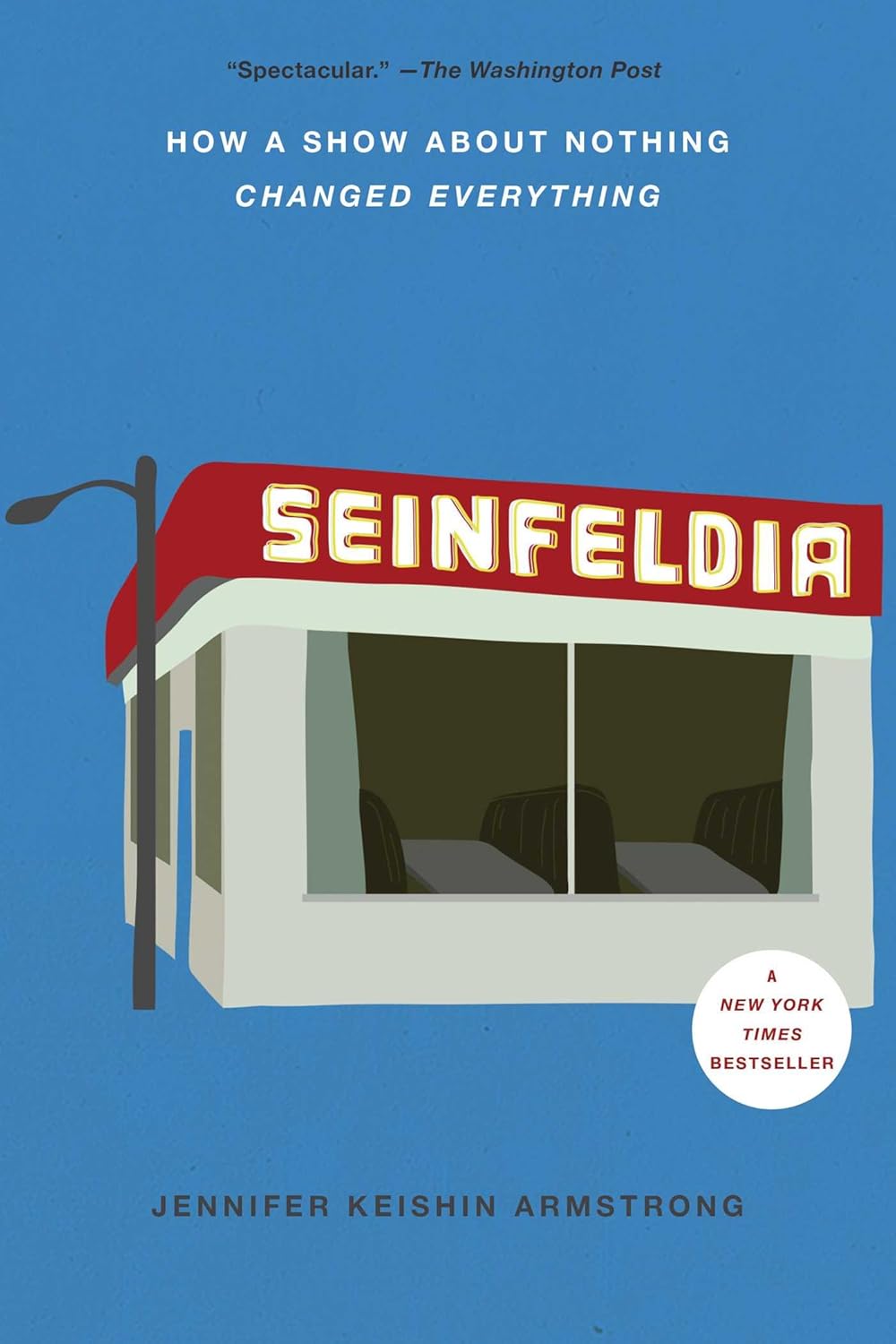
Seinfeldia: How a Show About Nothing Changed Everything by Jennifer Keishin Armstrong
Seinfeldia chronicles the unlikely rise of Seinfeld, the sitcom about “nothing” that grew into a cultural phenomenon watched by nearly forty million viewers at its peak. Packed with behind-the-scenes stories, show trivia, and writers’ room insights, the book explores how Larry David and Jerry Seinfeld created characters who became iconic and how the show’s legacy continues to shape pop culture long after its finale.
Buy the book now: Bookshop.org | Amazon










Leave A Comment