

Dr. Kate Mason is an executive communications coach, world-champion debater and author. Kate works with leaders at companies like Google, Netflix, Uber, Microsoft and more to help them navigate the tricky act of “communicating while female” at work. A veteran of high-stakes Silicon Valley roles, Kate brings a unique perspective to leadership. Her book, Powerfully Likeable has been called a “game-changer” by Publishers Weekly, and Kim Scott of Radical Candor calls it a “compelling, compassionate and funny read in which Mason shows you how to break free”.
As we enter a new year, it’s time to take an empowering step into 2026. Dr. Kate Mason’s message is one for the boardroom, but also can be applied to how you show up in front of agents, publishers, fellow writers and beyond. As we claim success as writers, let’s also claim some power. As we aim higher, let’s also stop shrinking. Hear how Dr. Mason made the shift and check out her book, Powerfully Likeable.
It’s circa 2010, and I’m standing on the eightieth floor of one of the biggest banks in the world, wobbling slightly in new heels and clutching a fancy leather folder I hoped made me look like I belonged. The room is full of men in suits. I am not in a suit.
I’m there to co-facilitate a workshop on storytelling—a topic I love—but I can already feel my shoulders tightening. My mind starts running background programs: Did they ask me because I’m good at this, or because they needed a woman in the room? What if they ask me to get coffee? I have about a hundred mental tabs open, all scanning for threats.
My colleague begins his introduction, and I’m starting to relax—until he mentions that I once held a world ranking in debate. I sit up straighter, grateful for the credibility boost.
And then, out of nowhere, a man seated nearby says loudly, “Ha! Lucky I didn’t marry you, then!”
The room erupts in laughter. My face burns. I smile—instinctively, stupidly—and then hate myself for it.
In that instant, I felt myself plummet from the eightieth floor. Every ounce of confidence evaporated. I wasn’t an expert or a guest or even a colleague anymore. I was the punchline.
That moment was one of the first times I became consciously self aware, in real time, how deeply women are trained to shrink—to soften, to smile, to smooth over other people’s discomfort even as it cuts into our own.
I wish I could say that experience was rare. But over the next decade, as I moved into executive coaching, I heard versions of that story again and again from women in every industry imaginable. Women who had worked twice as hard to earn their place at the table, only to find they still needed to make themselves smaller to stay there.
Those conversations eventually inspired my book, Powerfully Likeable: A Women’s Guide to Effective Communication. I wanted to understand not only the bias we face but the quiet ways we internalize it — what I call Imposing Syndrome.
Imposing Syndrome is the reflex to shrink before anyone else has the chance to make you feel small.
It sounds like:
“It’ll just take a second.”
“This might be wrong, but…”
“Sorry to bother…”
Smiling when being made the punchline of a joke in a room full of men.
It’s different from Imposter Syndrome. Imposter Syndrome whispers, You’re not good enough. Imposing Syndrome warns, You’re too much.
Research shows that this habit comes at a cost. Women are far more likely to use “powerless” speech—hedges, apologies, qualifiers—and are rated as less leadership-ready because of it.
Yet when we use the confident, direct language that earns men promotions, we’re often punished for being “aggressive” or “hard to work with.” It’s the impossible double bind: speak softly and disappear, or speak strongly and get penalized.
So, how do we break free from it? For me, it started with awareness—catching myself in the moment before I said just or sorry or does that make sense? and asking: What am I afraid of here?
Then I started swapping in new language that claimed my space:
“This will take five minutes; here’s what we need to decide.”
“Here’s what the data show—and what I recommend.”
Small shifts, but they changed everything. Not because the world suddenly became easier for women—it didn’t—but because I stopped apologizing for existing in it.
When I think back to that boardroom now, I no longer feel embarrassed. I feel motivated. That single offhand comment cracked something open—not just my composure, but my awareness. It was the start of a lifelong mission: to help other women recognize how often we shrink ourselves, and to remind them they don’t have to.
Because taking up space isn’t arrogance. It’s the quiet act of refusing to vanish.
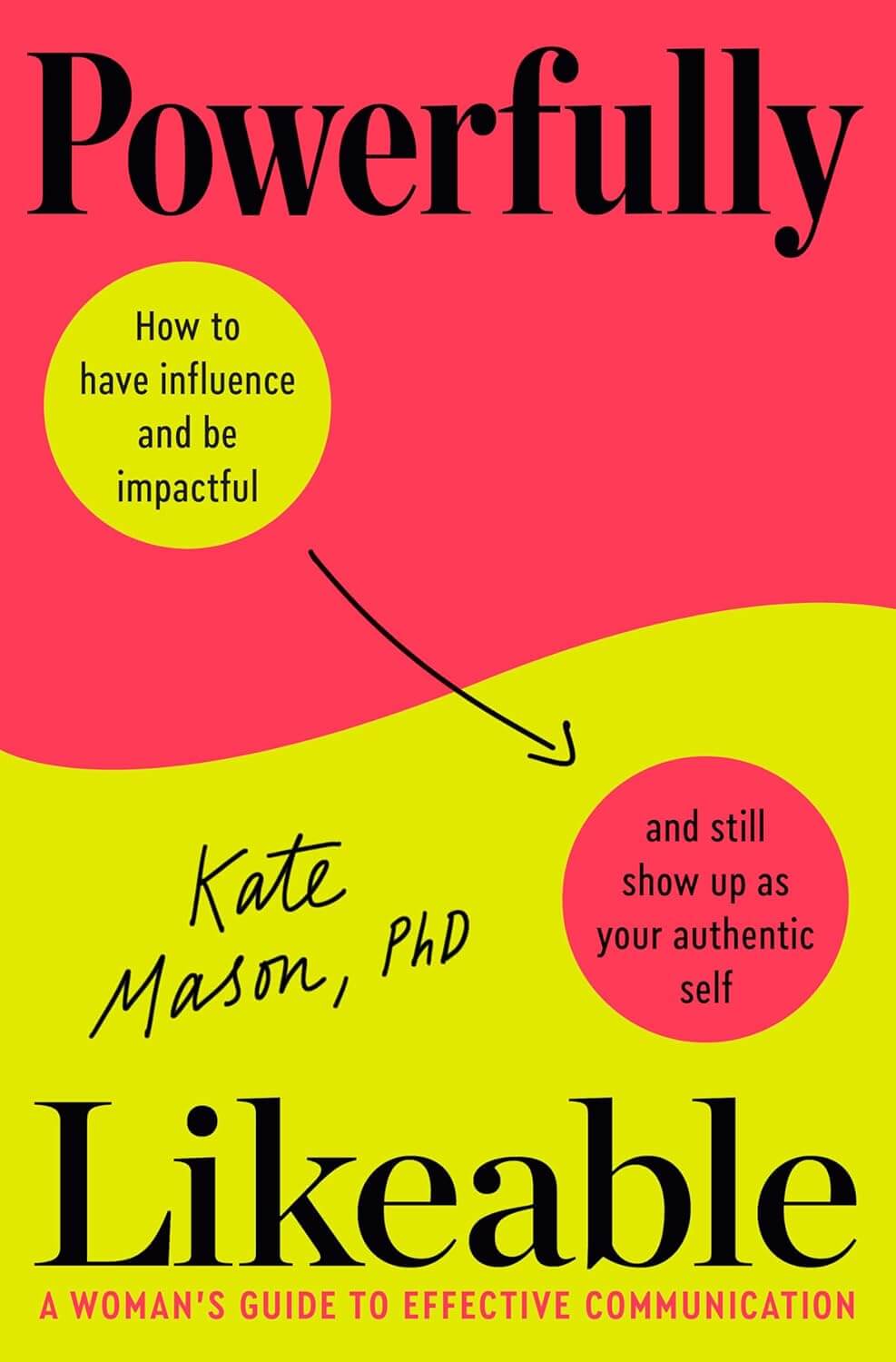
Powerfully Likeable: A Women’s Guide to Effective Communication by Kate Mason
Doctor Kate Mason has been the woman in the room before, and has had to learn how to take up space and be seen without being rejected. In her book, she dives deep into what it means to gain respect as a woman without trying to imitate men. Effective communication is a tool to be used to become your own number one advocate and harnessing what makes you unique and turning it into a super power. For everyone who is ready to begin a journey of self love and success, Kate Mason has laid out the roadmap.
Buy the book now: Bookshop.org | Amazon













Leave A Comment