

Peabody and Emmy award-winning documentary filmmaker Larkin McPhee brings the same penetrating curiosity and emotional depth that have defined her acclaimed film career to her debut memoir I’ll See You in My Dreams: A Sister’s Memoir (June 10, Köehler Books). In the book, she shares a deeply personal story of her brother Charles McPhee, the nationally known dream expert and host of The Dream Doctor Show, whose life, work, and death from ALS left an incredible mark on his family and on the thousands of listeners who found meaning and comfort in his voice.
I was lucky to have a kindred spirit in my brother, Charles McPhee, a person who looked after me even though I was 21 months older than him and who inspired me creatively as a documentary filmmaker. Sadly, he was diagnosed with ALS, a fatal neurodegenerative disease, at age 44. He died five years later in 2011. I missed him terribly over the next decade. I decided to write my debut memoir, I’ll See You In My Dreams: A Sister’s Memoir, about our spectacular friendship and all the many ways he creatively influenced me.
As host of the nationally syndicated radio program The Dream Doctor Show, Charles made a living deciphering the hidden language and meaning of people’s dreams. He had a deft touch, greeting his listeners with warmth and humor. They often called in with convoluted dreams about people in their lives or wacky encounters with tigers, earthquakes, or airplanes falling from the skies that they could not make sense of. I always marveled at Charles’s ability, after a few quick questions, to decipher the meaning of people’s dreams.
His line of questioning paralleled my own approach as a filmmaker. First, you cast a wide net around your subject and whatever issue you are exploring with them. Then, ever so delicately, you tighten the circle of inquiry until you land on the nub of the issue. For example, a 27-year-old woman called into The Dream Doctor Show one evening and described a recurring dream to Charles about running away from an Easter Bunny with a chainsaw. Charles asked for details. “Drew, paint the picture for us a little bit. How big is this bunny rabbit that’s chasing you, and what is he doing with a chainsaw?” The woman told him that this Easter Bunny stood a good foot over her and “he’s trying to get me,” she said.
My brother knew instantly that this dream was about sexual abuse. But he held back and instead told Drew that Easter Bunnies in dreams are symbols of fertility and sexuality. He was laying the groundwork for her to make a connection to something frightening that had happened to her around the age of 12 when the dream first occurred. I remember following a similar line of questions when I interviewed a ballerina for a documentary I was producing on eating disorders for the NOVA science series on PBS. The imperative to be abnormally thin dominated this ballerina’s life and she had developed an eating disorder. I sensed a deep well of pain in my pre-interview research call with her. I had no dream from her to analyze or telegraph to me what was really going on. Instead, I noted her comments in my journal and held back further questions until the camera was rolling.
On the radio, my brother asked Drew what male figure had threatened her at the tender age of 12. “It was an uncle, actually,” she said, “and I am recently thinking that this is stemming from possibly an abuse issue that I am not understanding and have blocked out.” He had read what Drew could not yet say. In my case, I waited to interview my ballerina in person. I had sensed a deeper story and she revealed that she had been cutting herself. Charles and I talked about this delicate dance that we both did in our crafts to gently probe the depths of people’s emotions.
Charles was my creative muse in life and his fascination with dreams made me pay attention to my own. Charles always used to say dreams are your friends and they are there to help you if you let them. Dreams can also be humorous. In the writing of my memoir, I had written a funny scene about my family and brother that my writing coach told me to cut. Normally I listened to her but I was somewhat enamored with this scene and resisted. That night, I had a dream about a snake leaping towards me and biting my right hand. I could not shake it off. Its jaws were locked on my hand. I woke up and knew instantly that I had to cut that writing scene. The snake was telling me that something was not “right” as in my right hand, which sounds like “writer.” I guess my subconscious agreed with my coach despite my ego trying to hang on to one of my “little darlings.”
Interestingly, it was not until I wrote the memoir that I realized how big an influence Charles had been on my life and my career as a documentary film producer and director. Growing up, Charles’s fascination with dreams and the subconscious oriented me to a brand-new language, one that we would come to share that was filled with visual metaphor and symbolism. Learning how to interpret dreams from my brother primed me to see and read the world visually, to employ some of those same familiar dream symbols as a film director.
Our subconscious minds are great storytellers, I would learn, and often provide riveting visual narrative. I so often took cues from dream symbols as a way to contextualize participants in my films. For example, in a documentary on depression for PBS, I filmed the CEO of a Fortune 100 company riding up in a glass elevator, a sure sign of success in a dream. In another sequence, I filmed a Bloods gang member in front of the George Washington Bridge in New York City to capture his desire to leave behind the gang and cross over into a new world. Additionally, the body of water, the Hudson River, flowing behind him represented our emotions, in this case the ones he was wrestling with, another classic symbol in dreams from our subconscious minds.
Perhaps the greatest gift my brother gave me was the importance of being present—for our films, for our subjects, and for our own lives. When you listen, you hear more than words. You hear the pauses, the stumbles, the silences where a person is gathering their courage to say something out loud for the first time. It is in those silences that you find the way into the bedrock of someone’s experience. Charles knew this on the radio. I learned it behind the camera.
I learned it again writing this book. The snake that bit my writing hand was Charles’s lesson coming back to me one more time: pay attention, the dream is trying to help you. In the years since he died, I have come to understand that the memoir itself was a kind of long dream-interpretation, an attempt to read the symbols of a life I shared with my brother and to find their meaning while I still could. He spent his career teaching strangers that their dreams were friends, there to help them if they listened. Writing about my brother, I came to see that dreams and his beautiful presence in my life were helping me to become a more complete person.
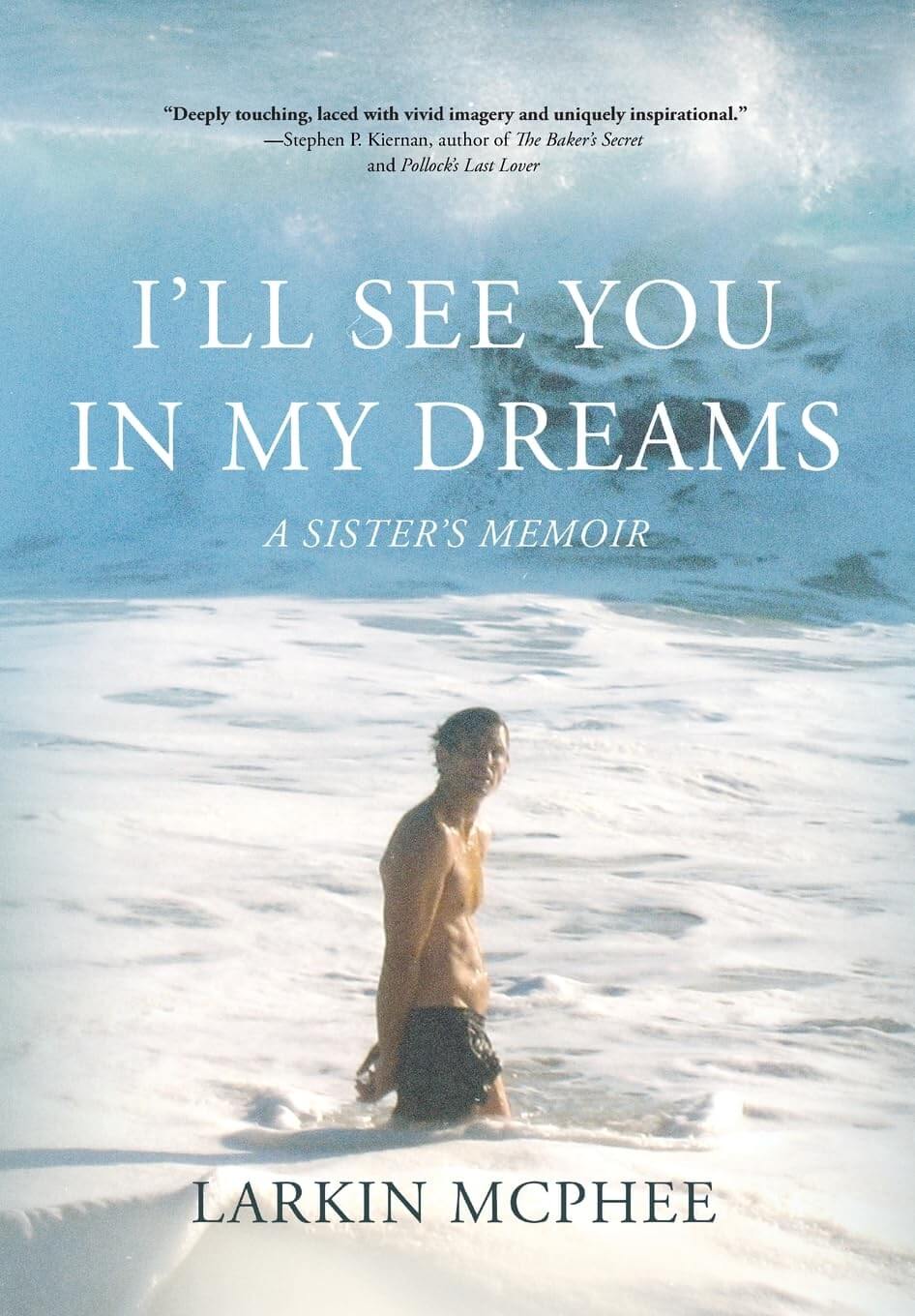 I’ll See You In My Dreams : A Sister’s Memoir by Larkin McPhee
This is the story of Larkin McPhee, a Peabody and Emmy award-winning documentary filmmaker, and her younger brother Charles McPhee, host of the nationally syndicated radio program The Dream Doctor Show and their lives together. At just forty-four, Charles was diagnosed with ALS, the fatal neurodegenerative disease. With memories, dreams, emails, and snippets of his radio show, Larkin looks back on her life with her brother both before and after his diagnosis. Charles had a profound impact on Larkin as a person but also as a filmmaker. In the daunting face of ALS, Charles was able to find beauty and hope, showing Larkin how to manage through hard times.
Buy the book now: Bookshop.org | Amazon

Leave A Comment