
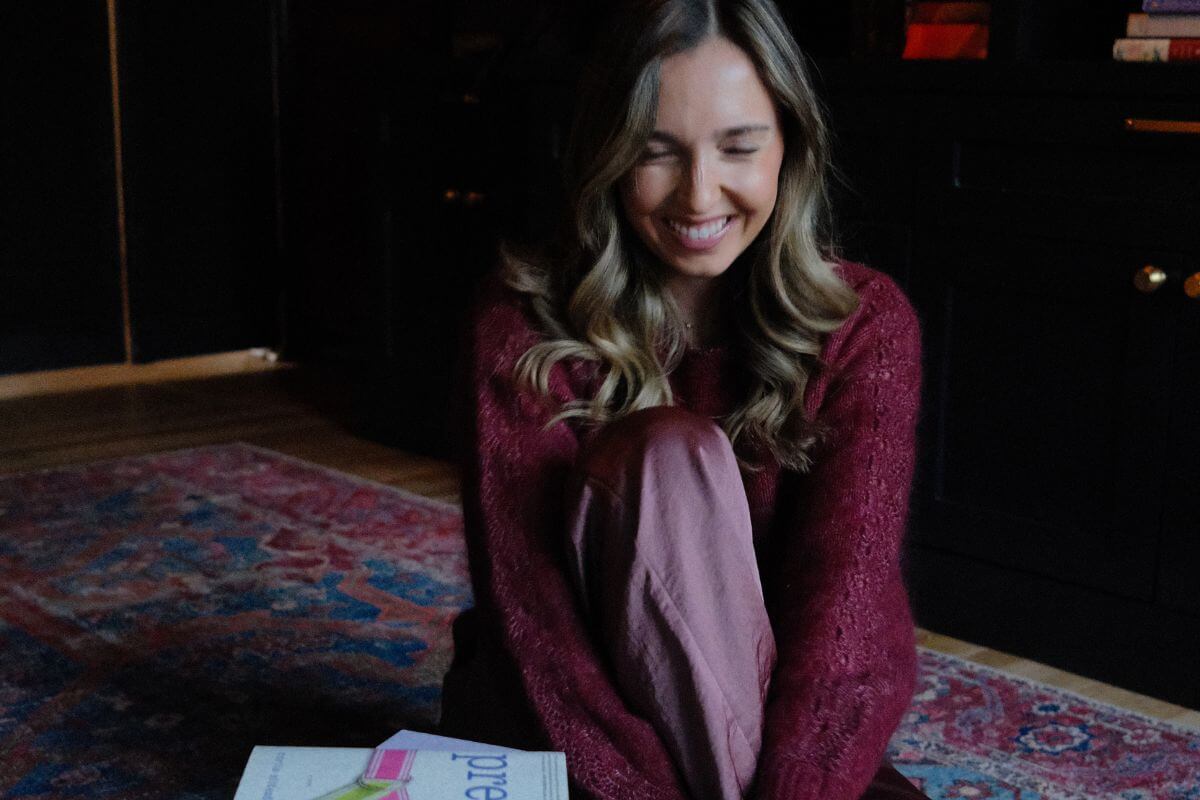
Mary Maeve Mcgeorge is a debut author whose work dissects the ways we deteriorate and blossom in the name of art. Her stories have won accolades from Writer’s Digest and Tulip Tree and have been featured in literary magazines such as Sunlight Press, Flora Fiction, Blue River Review, Visual Verse, Brown Bag Online, Heartland Society of Women and The Owl. She’s represented by Courtney Paganelli of Levine Greenberg Rostan literary agency. She currently lives in Austin, Texas with her husband.
The morning after I signed with my literary agent, I went to CVS to pick up a prescription. They weren’t open yet, so I sat down at the vaccine station and waited. Another man was already sitting there. We got to talking. I told him I was pregnant. He told me he was from China, but had come to America to work in tech. He asked what I did for work. I told him I’d just lost my job. He asked if that was allowed, them laying me off. I shrugged, said I didn’t think it really mattered to my company that I was expecting. I was a mere number on a spreadsheet. He agreed, then asked what I was going to do next.
I imagine I lit up then, my smile reflective of the very fact that just yesterday, after almost a decade of trying, my dreams had come true. “I’m going to be an author. I signed with a literary agent yesterday, actually.”
He winced.
It wasn’t the reaction I was expecting, though I suppose it shouldn’t have come as a surprise. I knew the tech world. I’d been a part of it since I graduated college, and I’d spent the last three or so years of my life working as a brand strategist for an automation-turned-AI company. The last six months of my time at the company, I produced the CEO’s podcast about AI transformation at scale. I was in charge of sourcing all guests, leaders from major tech conglomerates (most of which, you’ve heard of) who all, like birds echoing one another in an orchestrated song, believed AI was this inevitable revolution. Hop on the train, or get left behind. I knew these people, the antithesis to every writer I know. The antithesis, really, to me. And even though I’d just met this man, I knew him too.
He looked at me with sincere kindness in his eyes, and said, “You should find a different career. Something AI can’t replace.”
I don’t remember how I responded, but I do remember I didn’t feel like explaining myself to him. This was a much larger conversation, one that felt futile because I knew he couldn’t be convinced otherwise. He sincerely believed that I, as a writer, would get replaced by artificial intelligence and there was nothing I could say to change his mind.
This man saw that chatbots had been able to craft “narratives” and “prose” mimicking that of the great writers of our time—and before our time—and had taken that as proof that writing was something that would inevitably be replaced. As with all things in tech, his priority wasn’t the craft: it was the product. And he believed the product remained just as valuable even if the process of creation itself was streamlined. He believed AI would spill across every industry, every profession, and upend it. Publishing was no exception.
This man was sweet. This is not a piece to bash him. We had a lovely conversation, and he was genuinely worried about me.
This man was also wrong.
Here’s why.
In a capitalistic society, it’s inevitable that AI will replace some forms of writing.
Companies who value speed over quality will outsource most of their copyediting to artificial intelligence. Those in need of a ghostwriter likely won’t care too much about how a story is written, just that it gets done. The market is already being flooded with formulaic, book-shaped slop, and some generators have already managed to set up systems where they’re creating hundreds of books a year and driving well over six figures in sales. That’s an exceptional profitability ratio, so it makes sense he’d see this, and assume authors will eventually become irrelevant.
I don’t blame him.
Anyone who is immersed in the tech world can’t help but look at AI with money signs in their eyes, and at the end of the day, people just want to read a good book. Doesn’t matter how it comes to be.
However, this man, alongside so many others in the tech industry, remains eagerly blind to the fact that storytelling is one of the rare customs that has endured throughout time. And if we listen to history—and we always should—every democratizing technology from the printing press all the way to self-publishing platforms was theorized to make authors irrelevant by flooding the market. And every single one only sharpened the value of genuine, authentic voices.
It’s my opinion that human-crafted novels will become synonymous with fine art. Writers don’t write in the name of productivity. They write in the name of their soul, and that’s simply not something that can be automated.
I know this, because I’ve seen it happen before.
A corporate anecdote, as it applies to the arts.
At my previous company, it was less about what someone was writing and more about how much they could write, with AI generating as many blog posts, emails, landing pages, etc. as possible. We’d get rewarded for producing mass quantities of work, chastised if we spent too long on a single project.
Eventually, the creatives at my company started pushing back. They were producing more than ever, but the quality was drastically weaker. Was it more important to flood the market, or for us to stay true to our brand, and our voice, and our promise of quality to the customers?
When you optimize for speed of creation instead of letting yourself simmer in the point of a piece, you sacrifice quality. Authors typically take anywhere from a year to twenty years on their novels, and for good reason. The longer you sit with a story, the more you get to know it, the better it becomes.
Dig deeper into artificial intelligence, and you’ll find even more reasons why it doesn’t belong in the arts. Aside from the hallucinations and the fact that AI doesn’t have taste (you’ll never meet a greater people pleaser), artificial intelligence is probability-based. It’s only able to mimic great writers because it’s stolen the voice from those very writers (without consent, mind you).
Meaning these outputs aren’t art, they’re regurgitations. Nothing it does is original, and that’s why anything created by AI cannot be copyrighted. There’s no way to monetize AI-generated writing. Generators unconcerned with anyone “stealing” their work for profit—because it’s not really their work—might make a quick buck releasing hundreds of “books” on Amazon but this model isn’t sustainable long-term. Creating any sort of income from releasing mass slop will soon be—if it isn’t already—the equivalent of dumping water into the ocean. But publishers who depend on copyright to make a profit will be required to authenticate all novels to ensure they don’t invest in a book that can’t technically be sold.
The irrefutability of provenance.
I truly believe readers will always want books by real human authors who have endured real pain, real adventure, real life, and transferred their experiences into real work. Look at Shy Girl. People caught a whiff of AI in its pages, and all hell broke loose. The novel was cancelled. The author’s reputation was destroyed. The scandal was all the proof publishers needed to know that readers aren’t just buying words—they’re buying provenance.
In a world of people rushing to automate the “mundanity” of writing, the writers who continue to water the fertile grounds of their minds, and of their craft, will stand out. Because they—unlike the rest of the world, so eager to taste this AI-infused Kool-Aid—don’t depend on a machine for their artistry. They’ll be the ones who stayed true to their words, to their soul, thus the ones that become a rarity.
I didn’t say this to the man. I don’t like being in environments where I feel like I have to prove myself and that moment was shaping up to be exactly that—me, a writer who had spent well over a decade chasing a dream he was deeming obsolete.
However, if I were to go back, I would ask him one thing: Why do you want a world where writers aren’t valued anymore?
I’d really be curious to know.



Leave A Comment