

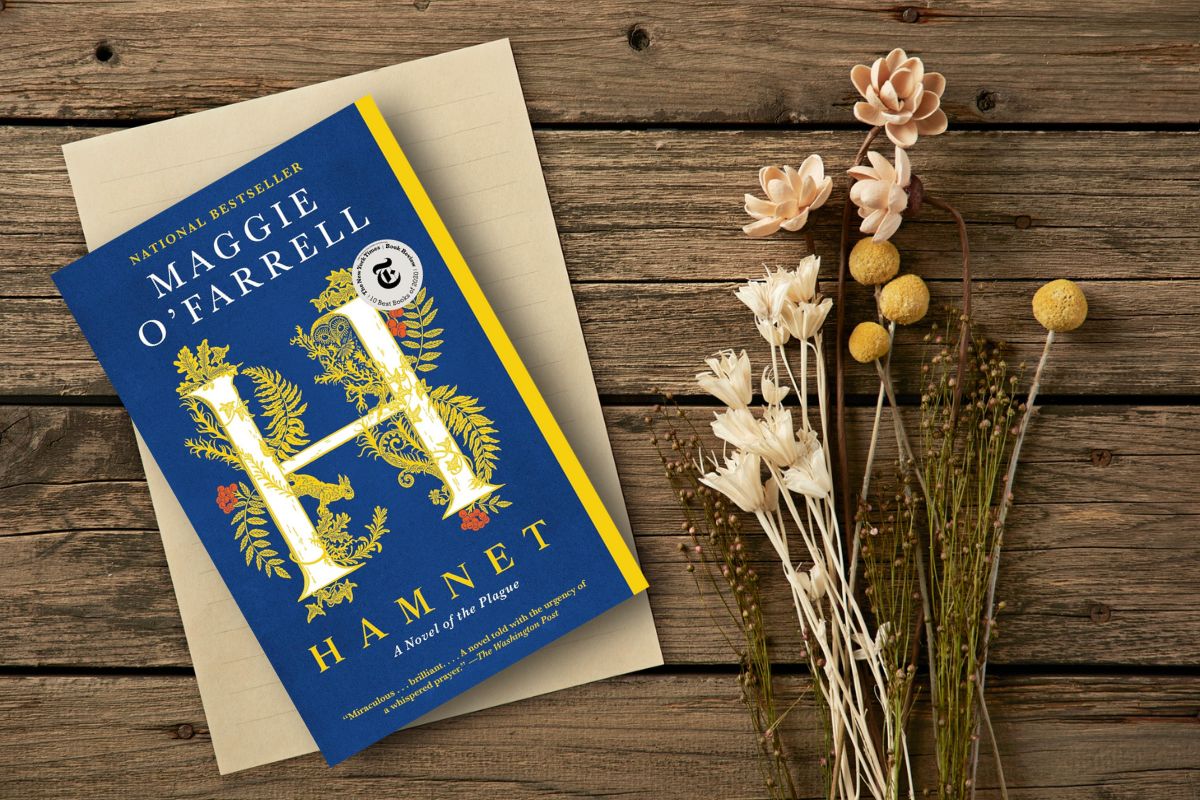
This month we’re celebrating the master work that is both Shakespeare himself and the modern powerhouse, Maggie O’Farrell. As Hamnet hits theaters, we watch the work of two brilliant artists unfold. If you’ve been touched by either of their masterpieces, you may be wondering how you can channel some of that greatness into your own story. Below we’ve outlined some of the techniques Shakespeare uses in his legendary tales that you can extract in the creation of your novel.
Imagery
Shakespeare is a master of imagery. His tragedies exemplify it the clearest. The language used paints pictures that convey emotion and raise the stakes. How a character sees the world can affect the way they convey imagery through their perspective and dialogue—both internal and external.
Prose writers can use this to convey details through their characters’ observations by showing how they see the world. For example, Romeo and Juliet are both far naiver characters than Macbeth or Hamlet, and the imagery conveyed by the latter characters is grittier and dim compared to the romantic counterparts.
Shakespeare’s imagery is so layered that it would take an entire academic research paper to dissect alone, but here are a couple key examples:
“Stars, hide your fires;
Let not light see my black and deep desires:
The eye wink at the hand; yet let that be,
Which the eye fears, when it is done, to see” (1.4.50-53).
In Macbeth, Macbeth as a character is truly so timid and fearful. He cowers before each and every decision he makes, often needing to be urged into it by another character such as Lady Macbeth or being forced to act by aspects of the narrative itself.
“O, she doth teach the torches to burn bright!
It seems she hangs upon the cheek of night
Like a rich jewel in an Ethiop’s ear;
Beauty too rich for use, for earth too dear!
So shows a snowy dove trooping with crows,
As yonder lady o’er her fellows shows” (I.5.45-50).
In Romeo and Juliet, we see Romeo comparing Juliet to a light far purer than other maidens (such as Rosaline), putting her up on a pedestal that is almost entirely unreachable. She is the sun, she is all of the stars, she is a perfect, snowy, gentle dove. Prose writers can reveal so much about their characters by showcasing the world through their MC’s eyes.
Stage Direction
While stage directions serve as a communication between playwright and actor, authors can find quite a bit of wisdom in Shakespeare’s work in the sidelines. For this, prose writers will need to be prepared to cozy up to watch a few live performances of Shakespeare productions (the more varied, the better) and take notes. Anyone can enter stage left, but how the actor uses their character’s personality is where the writing inspiration can shine through. This liberty is taken to its logical extreme in the 1996 film Romeo + Juliet, a completely modern take on the play but with dialogue ripped straight from the early modern English of Shakespeare.
Let’s be honest. All writing is just words on a page. Character, however, is what happens when those words come to life, whether that’s on the stage or in our minds.
The direction “[Exit, pursued by a bear]” in The Winter’s Tale is one of the more humorous stage directions that has gained modern popularity for its outrageousness.
How different adaptations of the play take it is where the fun begins. Sometimes, there’s real bears. Sometimes, there’s people in bear costumes. Sometimes, there’s the sound effects of the bear playing loudly and we are left to imagine the carnage. Sometimes, there’s a secret, funnier, fourth option. Writers are often reminded to avoid writing in a way that sounds too similar to stage directions, but they should not hold themselves back from unlocking the secrets of character writing that lie within them.
Imagine how your characters would move about the world and what that tells your audience. Think of movement as another tool for character development and plot. Does your MC flinch when their father approaches? Do they tug at their hair while they wait to get called in by their boss? Try to picture a scene unfolding in front of you and create action rather than just thought and dialogue.
Word Play and Double Meanings
Shakespeare is a master of word play and double meaning. A well-known example is “The beast with two backs” (1.1.127) in Othello, a common double meaning used today to speak around acts of passion, or the lines directly following:
“‘Thou art a villain.’
‘You are– a senator’” (1.1.128-129).
This small interaction here can be used by authors in prose, and not just in their dialogue. Each word on a page takes up precious space, it is imperative to make each and every single one count—and if you can pack more than one meaning into it, even better.
Weaving in double meanings can both enrich a story as well as allow readers put together pieces of a puzzle that make dissecting a story twice as fun. You want to avoid characters who always say exactly what they mean. As an author you can create mystery, symbolism, allusion and more by crafting your words carefully and with intention. Shakespeare offers winks and nudges for his audience that brings nuance to his work. Seize the opportunity to invite readers in with a playful maze of language.
Aside
An aside may be a little harder to adapt into prose, considering it is when a character directly speaks to the audience. It would be hard to integrate Bella Swan looking to the reader and making a comment about the absurdity of the Cullens’ passing themselves off as a foster family in the same way Hamlet can look off to the audience and clue us in. That said, it’s definitely not something to write off, either.
When Shakespeare characters make an aside, such as in Hamlet:
“‘But now, my cousin Hamlet, and my son,–’
[Aside] ‘A little more than kin, and less than kind’” (1.2.66-67).
In this interaction between Hamlet and his cousin and stepfather the King, Hamlet clues the audience in to his true feelings, unknown to the others within the play. He is doubly related to this man, yet cares for him little. In a prose novel, there is so much potential for a character to establish a relationship with the reader, or to interject with extra context that can build the world within the story.
Opportunities like entries in a journal or news clippings can offer readers context and insight that perhaps wouldn’t naturally occur in dialogue. Interiority is perhaps a novel-writers greatest tool for taking a reader deeper into a character’s thoughts, beliefs, hopes or fears.
Though this plays out as an aside on the stage, consider what sort of “asides” you want to have with your reader. What do you want them to know that no one else in the story does? How can you offer insight while sustaining suspense and mystery? What must your readers know that they can’t share with anyone else? Whether it’s a secret they are harboring, jealousy they are carrying or a plan they’ve concocted, consider why Shakespeare uses asides and find ways to fold that in to your writing.
When we look at someone like Shakespeare, it’s often hard to imagine achieving such a transcendent level of greatness. If you approach writing trying to achieve the eternal glory of a work like Hamlet, the daunt can stop you in your tracks. But when you look at the parts, you can start to weave some of his genius into your work.












Leave A Comment